Arnold Hospitality Press · David Arnold
Water Treatment & Technical Reference
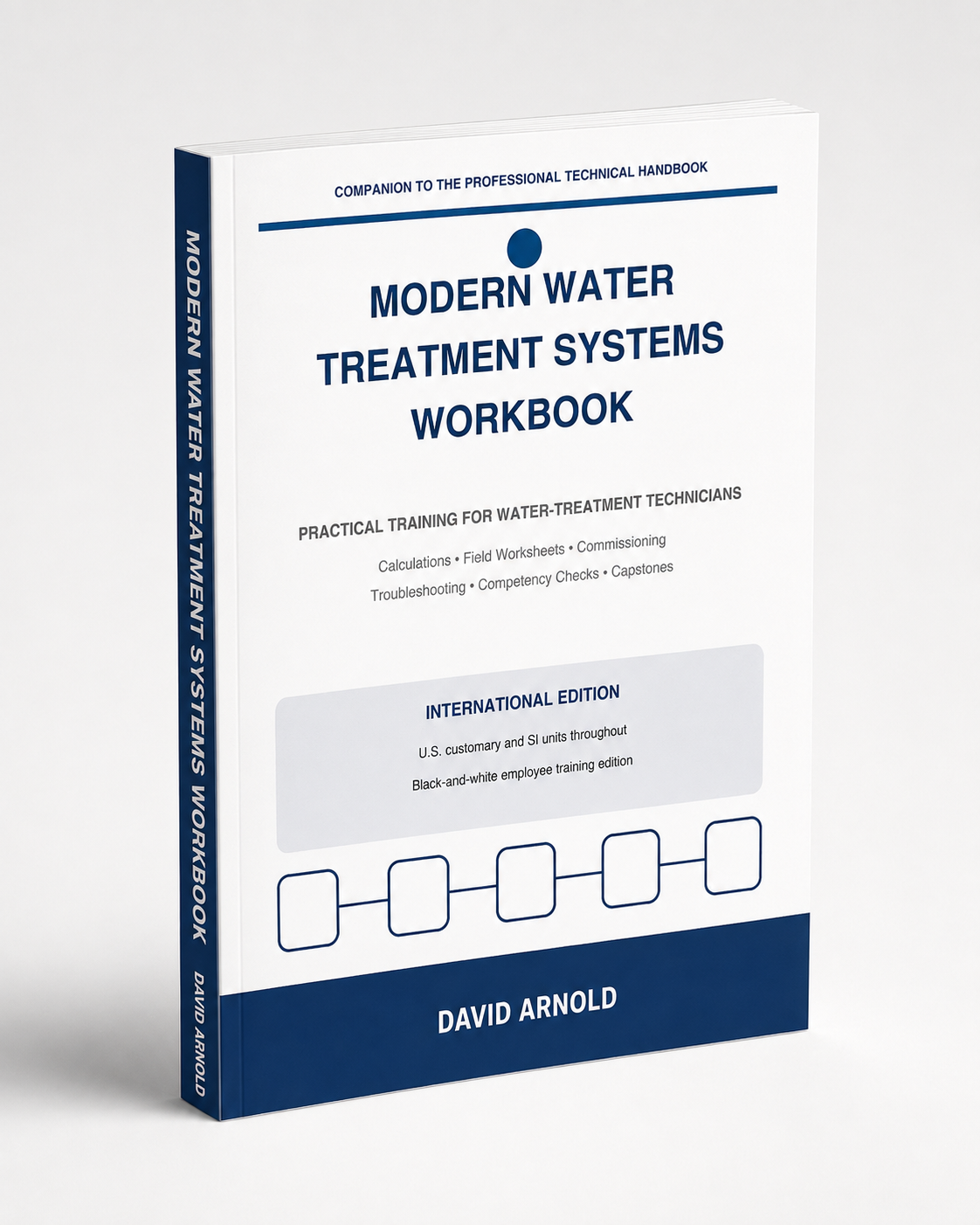
MODERN WATER TREATMENT SYSTEMS WORKBOOK
Practical Exercises, Field Worksheets, Calculations, and Troubleshooting for Water-Treatment Technicians
Show the units. Observe the task. Verify the result.

Inside the operation
Reading the method is the start. Applying it is the training.
A calculation needs a unit, a field observation needs a record and a practical task needs more than a completed training form. The workbook turns the handbook’s principles into work a learner and trainer can review.
Modern Water Treatment Systems Workbook combines guided calculations, field worksheets, commissioning checks and troubleshooting practice, with answer sheets for review after the work is complete.
The international training edition presents U.S. customary and SI units and a progression from technician essentials to system diagnosis and advanced professional work.
Written for water-treatment technicians, trainers and professionals who need to connect principles with field application.
The book’s practical approach
Show the units. Observe the task. Verify the result.
Prepare With the Handbook
Read the matching chapter before beginning the module.
Make the Calculation Traceable
State what is known, choose the formula, show units and check whether the answer is reasonable.
Practice and Review
Use instruments and field forms, have a trainer observe practical tasks and correct errors clearly.
Put the book to work
Continue the technical study.
Explore the companion reference in this technical collection.
Read an excerpt · How to Learn From This Workbook through the Treatment-Train Worksheet Method
A Little Taste of the Book
From Modern Water Treatment Systems Workbook
How to Learn From This Workbook
• Read the handbook chapter before the module.
• Show the formula and units for every calculation.
• Record facts before opinions during troubleshooting.
• Use real instruments during field exercises whenever possible.
• Have a trainer observe practical tasks.
• Correct errors in a different color or with dated notes.
• Use the answer sheets only after you finish the work.
Three training levels
Level 1 - Technician Essentials: routine terms, measurements, and service tasks.Level 2 - System Design and Diagnosis: sizing, selection, commissioning, and common faults.Level 3 - Advanced Professional: commercial, industrial, membrane, high-purity, and root-cause work.
Dual-Unit Standard
U.S. customary units are shown first. SI units follow in parentheses. Always include the unit in your answer.
| Quantity | U.S. customary | SI |
|---|---|---|
| Length | 1 in. | 25.4 mm |
| Length | 1 ft | 0.3048 m |
| Volume | 1 U.S. gal | 3.785 L |
| Flow | 1 gpm | 3.785 L/min = 0.2271 m3/h |
| Pressure | 1 psi | 6.895 kPa |
| Mass | 1 lb | 0.4536 kg |
| Power | 1 hp | 0.746 kW |
| Hardness | 1 gpg | 17.1 mg/L as CaCO3 |
| Temperature | F | C = (F - 32) x 5/9 |
Rounding rule
Use enough digits to support the decision. For normal field work, two or three significant figures are usually enough. Do not report more precision than the instrument or source data can support.
Core Calculation Setup
Use this five-step method on every calculation:
1. Write what is known.
2. Write what must be found.
3. Choose the formula.
4. Substitute values with units.
5. Check whether the answer is reasonable.
Example
A system flows 10 gpm. Convert to L/min.10 gpm x 3.785 L/min per gpm = 37.85 L/min.Rounded answer: 37.9 L/min.
Treatment-Train Worksheet Method
1. Define the objective
Write measurable product-water goals and operating needs.
2. Document the feed
Source, analysis, flow, pressure, temperature, variability, and biological risk.
3. Select by mechanism
Choose processes that actually remove, reduce, exchange, oxidize, disinfect, or separate the target.
4. Put stages in order
Protect sensitive stages and provide contact, filtration, storage, or polishing as needed.
5. Add controls
Sample points, gauges, meters, alarms, bypass, redundancy, drains, and acceptance criteria.
Continue reading in Modern Water Treatment Systems Workbook
Available editions
Choose your edition
Use the printed workbook alongside the handbook and your training. Amazon provides current pricing and availability for your location.

About the author
David Arnold
David Arnold’s water-treatment background spans residential, commercial, industrial and high-purity work. His published professional history includes leadership of an independent water dealership, past presidency of the Indiana Water Quality Association and service on the Water Quality Association’s Board of Directors.
The workbook carries David’s emphasis on application, measurements and field discipline into guided technician practice.
Continue the work
Related reading
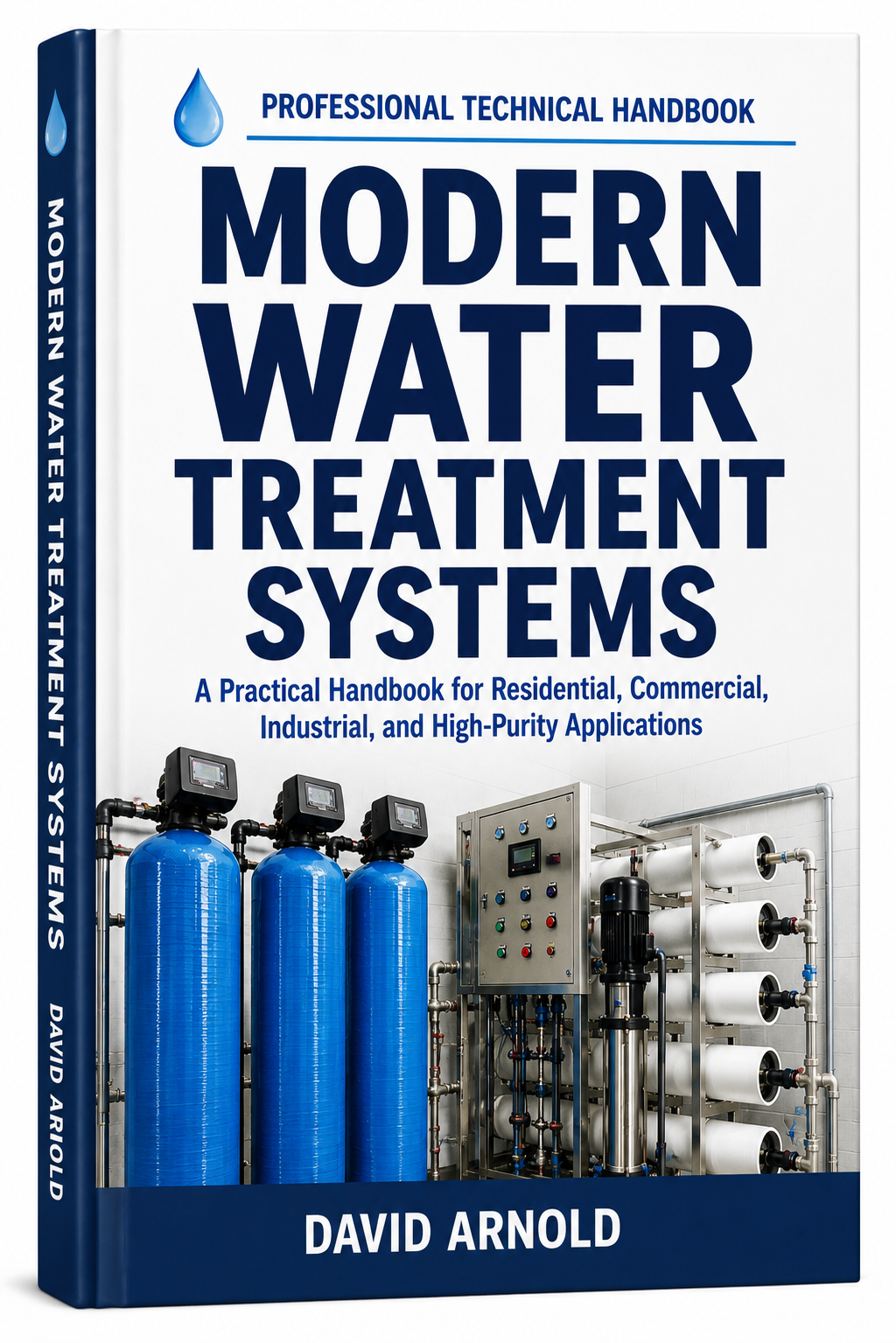
WATER TREATMENT & TECHNICAL REFERENCE
Modern Water Treatment Systems
A practical technical reference for understanding modern treatment systems.
Explore this book
PROFESSIONAL RESTAURANT LIBRARY
The Foodservice Operations System
Build standards, controls, training, and accountability into one dependable operating system.
Explore this bookMore resources and reading: Sop Toolkit · The Foodservice Operations Toolbox · Water Treatment Technical Reference
Practical support
Need help applying this in your operation?
Discuss your technical-training or water-treatment enquiry with David Arnold.