Whenever management tells me they have a food-cost problem, I have a fairly predictable response.
“Maybe.”
Food cost is certainly capable of being too high.
But the percentage appearing on your profit and loss statement didn’t walk into the cooler and spoil a case of produce.
It didn’t cut an eight-ounce portion when the specification called for six.
It didn’t overproduce 40 portions for lunch.
It didn’t forget to record waste.
And it certainly didn’t sign for a delivery nobody bothered to check.
Food cost doesn’t create problems. It reports them.
That’s an important distinction.
Because when management attacks the percentage instead of investigating what produced it, they frequently start fixing the wrong things.
“Raise the prices.”
“Change suppliers.”
“Reduce the portions.”
“Tell the chef to get food cost down.”
Maybe.
But first, let’s find out what’s actually happening.
Who Checked the Delivery?
There are two jobs in a foodservice operation that I particularly dislike.
Washing dishes and receiving deliveries.
My reasons for disliking dishwashing go back to how I entered this business. That’s another story.
Receiving is different.
My sister has been telling me for years that I’m gullible and trust far too many people.
She may have a point.
Because whenever I start working with a new operation, I eventually hear her voice in my head when I ask:
“Who checks in your deliveries?”
You’d be surprised how often the answer is the dishwasher or a commis cook.
The truck arrives.
Someone gets pulled away from another job.
Boxes come through the door.
The driver produces an invoice.
Someone signs it.
No scale.
No calculator.
No comparison with the purchase order.
No meaningful check of weights, specifications or prices.
Everybody assumes everything is correct.
But is it?
I recently saw a news investigation involving a supermarket chain I shop at reporting that weights on some products sold by the pound were overstated by around 15 percent.
That number caught my attention.
Imagine what 15 percent means when you’re buying expensive proteins commercially.
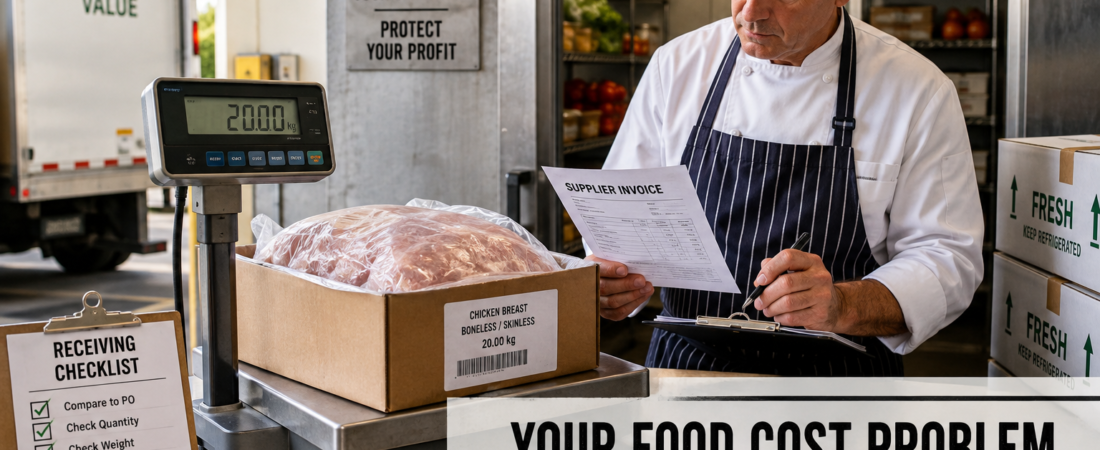
The invoice says 20 kilos.
Did you receive 20 kilos?
If nobody weighed it, you don’t know.
And there’s our first lesson about food cost.
You can negotiate wonderful supplier prices and still lose money at the receiving door.
Start With the Operation, Not the Percentage
Suppose your target food cost is 30 percent and you’re running 34 percent.
Four points gets everyone’s attention.
Management often immediately starts looking at purchasing.
“Can we get chicken cheaper?”
“Why are we paying so much for beef?”
“Let’s get another produce quote.”
Absolutely negotiate your purchasing.
But before blaming your supplier’s price, I want to know what happens to the product from the moment it reaches your property until the moment it reaches the guest.
Receiving is merely the first control point.
Next, I’m going to the storeroom.
Your Storeroom Is Full of Money
I can learn a tremendous amount about an operation by walking through its dry storage, refrigerators and freezers.
Sometimes I learn more there than I do sitting in the manager’s office looking at reports.
Open containers.
Missing labels.
Duplicate products.
Poor rotation.
Expired inventory.
Three brands of the same ingredient.
Unrecorded prepared food.
High-value proteins sitting wherever someone found room.
Products nobody seems to remember ordering.
Management sometimes treats these as housekeeping problems.
They’re not.
They’re financial-control problems.
Every product sitting on those shelves represents cash.
If you wouldn’t leave several thousand dollars in cash scattered around an office without controls, don’t treat your food inventory that way either.
A Recipe Is Also a Financial Document
Now let’s go to production.
Ask five cooks to make the same menu item without a standardized recipe and you may get five different food costs.
One uses six ounces of sauce.
Another uses eight.
Someone grabs the wrong ladle.
Another cook adds “a little extra” cheese.
A garnish is supposed to be four ounces but gets portioned by eye.
None of those decisions looks catastrophic during one service.
Multiply them by hundreds of covers.
Then multiply that by 365 days.
Now we have a problem.
A standardized recipe isn’t merely a cooking instruction.
It is a production specification, a quality standard and a financial control.
It defines what the guest receives and what the operation should spend producing it.
Without controlling one, you cannot reliably control the other.
Portion Control Isn’t About Giving the Guest Less
This is another area where management sometimes gets things wrong.
Portion control does not mean shrinking everything until the customer complains.
It means consistency.
If you’re selling a 14-ounce steak, serve a 14-ounce steak.
If the specification says six ounces of mashed potatoes, serve six ounces.
Not five today, eight tomorrow and whatever fits nicely on the plate Saturday night.
The customer who loved the dish Tuesday should receive essentially the same dish Friday.
Consistency protects both your margin and your reputation.
“Make Some Extra” Isn’t a Production System
One of the more expensive phrases in foodservice is:
“We’d better make some extra just in case.”
Of course we need sensible buffers.
But “just in case” isn’t forecasting.
Production should reflect actual business patterns: sales history, reservations, expected covers, day of week, events, shelf life and other relevant demand factors.
If you repeatedly prepare 60 portions and sell 38, your problem isn’t food cost.
Your problem is production planning.
Food cost is simply showing you what that problem costs.
Put the Waste on Paper
Ask a kitchen how much food it wastes and the answer is often:
“Not much.”
Fine.
Let’s measure it.
Trim loss.
Spoilage.
Overproduction.
Dropped product.
Burned food.
Preparation mistakes.
Incorrect orders.
Returned dishes.
Expired inventory.
All of it gets recorded.
The purpose isn’t to punish employees for admitting something was wasted. Do that and they’ll simply stop telling you.
We’re looking for patterns.
Why do we throw away the same soup every Thursday?
Why does one protein consistently show excessive trim loss?
Why does one shift produce substantially more waste than another?
Once we know, management can act.
What gets recorded can be managed. What disappears into the garbage cannot.
The Dining Room Can Hurt Food Cost Too
Don’t make the mistake of treating food cost exclusively as a kitchen responsibility.
A server enters the wrong modifier.
An item gets incorrectly voided.
A comp isn’t recorded properly.
Extra proteins, sauces or toppings leave the kitchen without being entered into the POS.
The guest orders one item and receives another.
The kitchen remakes the plate.
We’ve now produced two meals and collected revenue for one.
Again, the food-cost percentage didn’t cause anything.
The operating process did.
Now We Come Back to Inventory
Remember our delivery?
The one someone signed for at the back door?
Receiving told us what supposedly entered the operation.
Inventory helps us determine what’s still there.
Sales tell us what supposedly went out through the register.
Production records, transfers and waste should help explain much of what happened in between.
When those numbers don’t reconcile logically, we have something to investigate.
Maybe it’s waste.
Maybe it’s overportioning.
Maybe receiving.
Maybe theft.
Maybe an invoice error.
Maybe an inventory-counting problem.
The important thing isn’t merely identifying the variance.
Management’s job is tracing the variance back to the process that created it.
Sometimes Nothing Is Wrong With the Kitchen
There’s another possibility.
Your food-cost percentage increased even though the operation performed correctly.
Customers may simply have purchased a different mix of menu items.
That’s why managing from one overall food-cost percentage can be dangerous.
I want to know:
What should our food cost have been based on what we actually sold?
Then:
What was our actual food cost?
And finally:
What explains the difference?
Now we’re managing.
Don’t Make Your Customers Pay for Bad Controls
Raising menu prices can improve margins.
Sometimes it’s absolutely necessary.
But price increases can also temporarily hide poor operations.
If you’re losing money through weak receiving, uncontrolled portions, overproduction, excessive waste and sloppy inventory, raising prices doesn’t solve those problems.
It simply asks your customers to pay for them.
Eventually, they’ll stop.
Fix the operating leaks first.
Then determine whether the menu is priced correctly.
Food Cost Is Telling You Something
When I see an unfavorable food-cost number, I don’t immediately start changing menu prices.
I start walking.
Receiving.
Storerooms.
Coolers.
Freezers.
Production.
Portioning.
Waste.
Inventory.
POS controls.
Then I compare theoretical cost against actual cost and talk with the people doing the work.
Eventually the numbers and the operation usually start telling the same story.
That’s when we can actually fix something.
Sustainable food-cost improvement doesn’t come from telling a chef:
“Watch your food cost.”
It comes from purchasing specifications, disciplined receiving, standardized recipes, controlled portions, planned production, recorded waste, accurate inventory and management follow-through.
And sometimes it starts with an even simpler question:
“Who checked in the delivery?”
Because your food cost may indeed be too high.
But the percentage isn’t the problem.
It’s evidence that you have one.
To put the checks into practice, use the Food Cost Calculator and Edible Yield Calculator with current purchasing and preparation records. For the wider operating controls, explore The Restaurant Food Cost Rescue Plan.