How a Perfect Welcome Became a Hospitality Disaster
As you may have guessed by now, I travel a lot. It has been an integral part of my work for most of my career, and fortunately I genuinely enjoy it. I like discovering different countries, different cultures, different food, and especially the different ways people practice hospitality.
After spending a lifetime in this business, I find myself paying attention to things most guests probably never consciously notice. I notice how the door is opened, how a reservation is handled, what questions are asked, how the menu is presented, and whether the people working in the restaurant make hospitality feel natural or rehearsed.
One thing I have always believed is that information is king—or queen—but how you collect that information matters. I want a restaurant to know whether I have been there before, what kind of evening I am looking for, and whether there is something it can do to make the experience better. What I do not enjoy is being grilled by a stranger before I have had time to sit down.
There is a great difference between someone learning about you through a pleasant conversation and someone conducting what feels like an immigration interview beside the host stand.
Years ago, while working a large food show in Manchester, England, I saw both the very best and the very worst of hospitality in a single evening.
The show itself was exhausting. It ran for five days at roughly twelve hours a day, and anyone who has worked a trade show knows that the hours on the schedule do not really describe the experience. You stand most of the day, talk continuously, answer the same questions repeatedly, meet hundreds of people, and somehow remain pleasant while your feet are quietly filing a complaint with management.
By the end of the first day, I was tired, hungry, and in no mood to search half of Manchester for dinner.
My hotel was in a small village outside the city. There were several hotels nearby, along with pubs and restaurants within walking distance, so I asked the front desk where I should eat.
They recommended a restaurant whose name I no longer remember except that I am fairly certain it had “Duck” in it somewhere. The English have a particular gift for naming pubs and restaurants. Give them a duck, a fox, a king, a crooked something, and perhaps a pair of arms, and sooner or later they will have a perfectly respectable establishment.
Whatever this particular Duck Something was called, it looked promising.
There was a steady stream of people going in and out, which is usually encouraging. The building was attractive, the atmosphere looked warm, and after a twelve-hour day I was more than ready to allow somebody else to feed me.
Before I was properly through the entrance, a cheerful hostess opened the door.
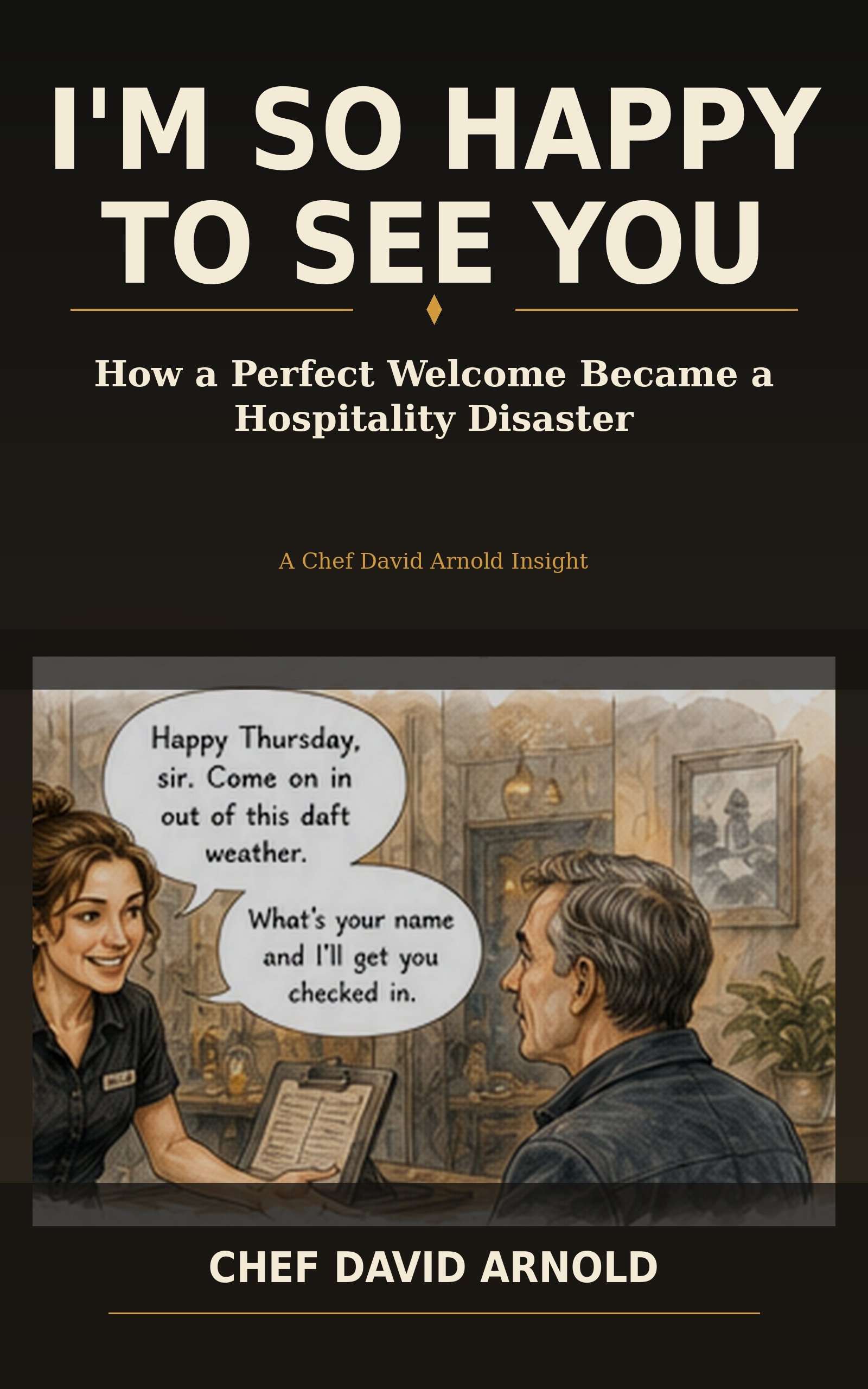
“Happy Thursday, sir. Come on in out of this daft weather.”
I liked her immediately.
She did not stare at a screen and ask, “Reservation?” She did not begin with, “How many?” She looked at me as though she was genuinely pleased that I had walked through the door. Then she asked my name and said she would get me checked in.
That little choice of words impressed me. Instead of asking whether I had a reservation and putting me in the position of proving that I belonged there, she simply assumed everything was going to be fine and started taking care of me.
I gave her my name, and suddenly she gave a little whoop of recognition.
“Sir! I’ve been expecting you. The hotel asked me to take special care of you.”
Well, now we were getting somewhere.
The hotel had apparently called ahead, which I thought was excellent service. Even better, the restaurant had actually done something with the information rather than accepting the call and forgetting about it thirty seconds later.
Then she casually added, “I don’t recognize your name, though. When was the last time you were here?”
Now she really had me.
She wanted to know whether I was a first-time guest, but she did not ask me the standard question. She worked it naturally into the conversation and got exactly the information she needed without making me feel like she was checking boxes.
Then she noticed the book I was carrying.
“Come with me. I’ll put you out of the way so you can read your book with some peace.”
At this point, I had contributed very little to the process. I had given her my name and followed instructions.
I love professionals.
She took me to a quiet table away from the busiest part of the room. Once I was seated, she opened the menu and wine list, pointed out the cocktail selection, and mentioned a particular drink they had created for special guests to help break the ice. Then she told me that Tommy would be taking care of me and would be over shortly.
“I hope you love your dinner, sir.”
And away she went.
I sat there thinking how beautifully the whole arrival had been handled. In a matter of minutes, this woman had learned that I was a first-time guest, understood that the hotel had sent me, recognized that I wanted a quieter table, introduced me to the menu and drinks, told me who my server would be, and then left me alone to relax.
There had been no fuss, no interrogation, and no unnecessary speech.
It was hospitality at its best.
Unfortunately, that was also approximately where the hospitality ended.