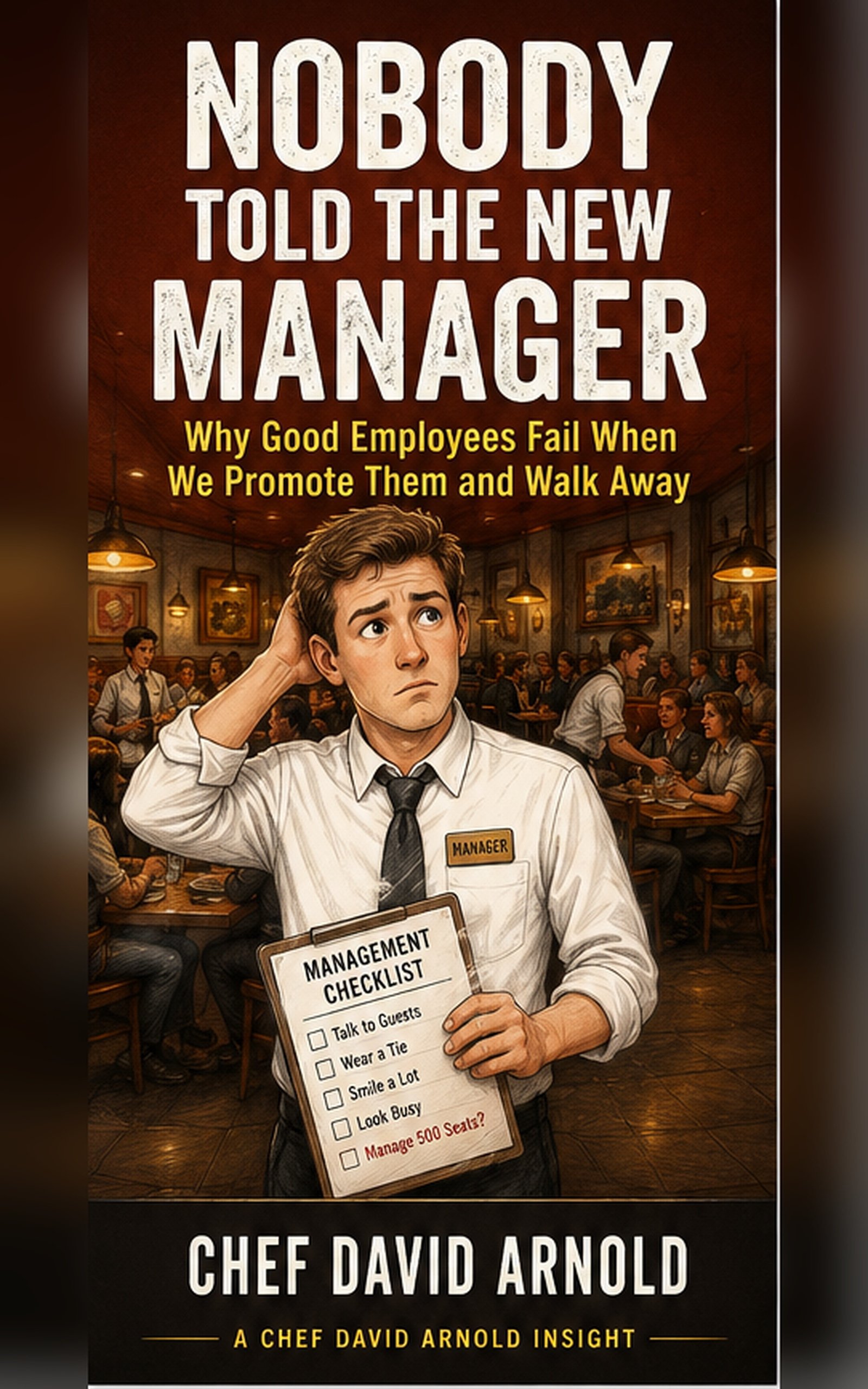
Why Good Employees Fail When We Promote Them and Walk Away
I was fourteen years old when I first went to work in a restaurant, although by that point restaurants were already familiar territory to me. My grandparents owned a coffee shop in a small Midwestern town, so I had grown up around grills, coffee pots, regular customers, and the peculiar rhythm of a business where everybody can be perfectly calm one minute and running in six directions the next.
My first real experience in a large restaurant operation came with Lucky Steer Family Restaurants. The location where I started was brand new and, to me, enormous. The place seated roughly five hundred people, and when it was busy, it was really busy. There could be customers lined up waiting for tables while the kitchen was buried in tickets, dishwashers were trying desperately to keep up, and somebody in management was wondering which employee was going to call in sick next.
I started at the bottom, which turned out to be a very good place to begin. I was a busboy and dishwasher. I cleared tables, carried tubs, washed plates, scrubbed pans, hauled garbage, mopped floors, and learned that every elegant meal eventually ends with somebody dealing with what is left behind.
From there I began moving into the kitchen. That was where I really found my place. I learned prep, worked different stations, became a cook, and eventually became a head cook. I liked the kitchen because the work made sense to me. Food was either ready or it was not. The steak was either cooked correctly or somebody was sending it back. The station was either set for the rush or you were about to discover, very publicly, that it was not.
Over time, I became pretty good at it. I understood production, timing, prep, and the way a kitchen changed personality when the dining room filled up. Lucky Steer was growing, and I began helping with new restaurant openings as well.
Somewhere along the way, somebody decided I was management material.
I am still not entirely certain why.
I suspect the decision was less mysterious than I imagined at the time. I worked hard, showed up, knew the operation, and could handle responsibility. In the restaurant business, those qualities have launched a great many management careers.
Somebody looks around the building, spots the dependable employee who knows what he is doing, and thinks, “He would probably make a good manager.”
That thought is not necessarily wrong.
The problem comes when the next thought is, “Good. Give him the keys.”
There is a rather large amount of information that should probably come between those two events.
In my case, the transition was not exactly overloaded with ceremony or formal education. There was no management academy, no carefully structured orientation program, and certainly no thick binder titled Everything David Needs to Know Before We Turn Him Loose on Five Hundred Seats of Restaurant.
As I remember it, the preparation was considerably simpler.
I was basically told not to screw it up because somebody would be watching.
Then I put on a tie.
The tie was important.
Until then I had spent my working life in restaurant clothes appropriate for doing actual restaurant work. Now I had a tie, which at that age seemed like fairly convincing evidence that I had entered the executive ranks.
The only minor problem was that nobody had really explained what management was.
So I did what seemed sensible.
I went into the dining room and started talking to customers.
I thought I was doing a terrific job.
I stopped at tables, asked people how their meals were, talked with guests waiting to be seated, answered questions about the menu, and made recommendations. For the first time, I was seeing the restaurant from the other side of the kitchen doors, and I found it fascinating.
After years of measuring a restaurant in tickets, steaks, baked potatoes, and prep lists, suddenly I was talking to the people who actually ate the food. It felt important, and more importantly, it felt managerial. I imagine I looked quite pleased with myself walking around that dining room in my tie, chatting with guests and believing I had discovered the secret to restaurant leadership.
The customers seemed happy. I was visible, attentive, and enjoying this new view of the operation. From where I stood, the whole management experiment appeared to be going remarkably well.
The actual manager had a slightly different assessment.
Eventually, he pulled me into the office. I do not remember his exact words after all these years, but I remember the message perfectly: I was not managing the restaurant.
That came as something of a shock because I thought I had been managing the daylights out of it.