Read the Kindle edition on Amazon · Browse more Insights
A good workplace can have loyalty, trust, friendship and genuine affection. But it still needs something a family doesn’t: professional boundaries and accountability.
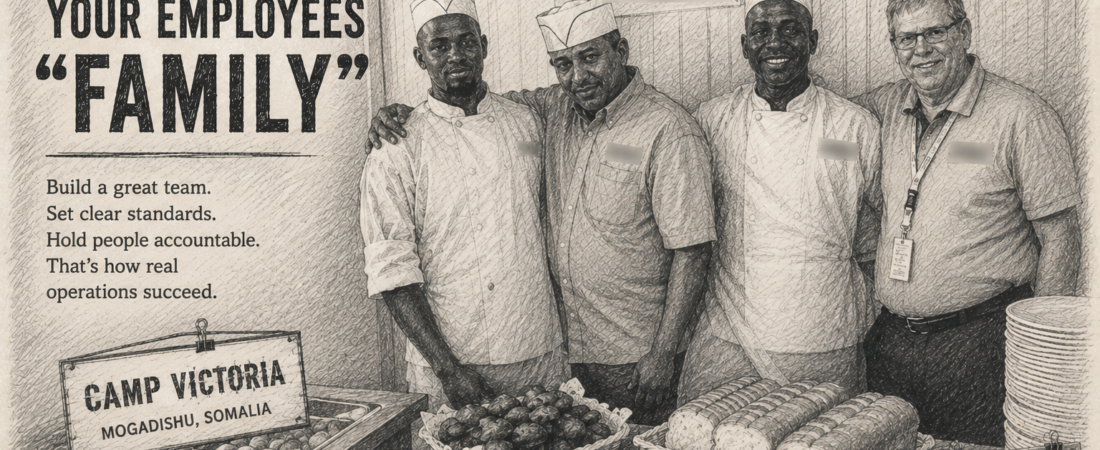
My first tour in Somalia was eye-opening, to say the least.
How I ended up there is an entirely different story—and one I will certainly tell another day.
This story is about false promises, unnecessary pressure, and what happens when we confuse professional relationships with personal ones.
On my first day in Mogadishu, I met the Country Manager. I liked him immediately. He was a good guy, personable and easy to talk to. His management style was very much about being everyone’s pal. He surrounded himself with people he considered friends and believed his friends wouldn’t let him down.
There was just one problem with that philosophy.
Friends sometimes let you down too.
But that’s another story.
After meeting his second-in-command and several of the senior people, we started making the rounds to meet some of the support staff.
Our first stop was Security.
That seemed like a particularly good place to start.
When I had stepped off the plane in Mogadishu the night before, I had been issued a Kevlar vest and a helmet.
This was not exactly standard equipment in most kitchens where I’d worked.
I’m a cook.
I’m not a soldier.
So meeting the man responsible for keeping us alive seemed like an excellent idea.
And this guy looked the part.
He was a brute of a man who radiated a very clear message:
Don’t mess with me.
Exactly what you want in the person running security in a place like Mogadishu.
We talked for a while, and eventually he began explaining the culture of the operation.
“We’re one big happy family here.”
I stopped him.
“Family?”
“YES!” he answered enthusiastically.
Now, I’ve always been a little suspicious when I walk into an operation and immediately hear people describing themselves as a family.
Sometimes it’s genuine affection.
Sometimes it’s management trying to manufacture loyalty.
And sometimes it’s simply a convenient way of avoiding the uncomfortable distinction between friendship and accountability.
So, being the smart aleck that I occasionally am, I looked at this enormous security man and calmly asked:
“Okay. Which one of my brothers is taking a bullet for me? Because I’m just the cook.”
That pretty much ended the family discussion.
But underneath the joke was something I’ve come to believe very strongly after decades of managing people:
Don’t mistake cooperation for friendship, and don’t mistake a good team for a family.
Leadership Gets Complicated When Everyone Is “Family”
There is nothing wrong with caring about the people who work for you.
Quite the opposite.
I’ve spent much of my career developing people. I’ve watched dishwashers become cooks, cooks become chefs, supervisors become managers, and young employees grow into professionals capable of running operations themselves.
A good leader should know his people.
You can know their spouses and children. Celebrate birthdays. Attend weddings. Share meals. Laugh together. Help someone through a difficult period. Recognize achievement. Mentor people. Occasionally disagree with them and still enjoy sitting down together afterward.
You can even develop friendships that continue long after the working relationship ends.
But none of that changes one important fact:
When you’re responsible for the operation, eventually you have to lead it.
And leadership sometimes requires doing things friendship doesn’t.
Someone repeatedly arrives late.
Someone ignores a food-safety procedure.
Someone refuses to follow a recipe or portion standard.
Someone mistreats another employee.
Someone doesn’t complete required work.
Someone is simply not capable of performing the job they’ve been hired to do.
A leader has to address it.
Sometimes that means coaching.
Sometimes retraining.
Sometimes a written warning.
Sometimes a final warning.
And occasionally it means telling someone that today is their last day.
That’s where the “family” philosophy starts causing trouble.
You don’t issue your brother a written warning.
You don’t put your mother on a performance-improvement plan.
And you don’t terminate your sister because labor cost is running four points over budget.
Businesses don’t operate on unconditional relationships. Families do.
“We’re Family” Can Become a Management Shortcut
Most managers who use the word family aren’t trying to manipulate anybody.
Usually they mean something positive.
We take care of each other.
We work together.
We don’t abandon somebody when things get difficult.
Those are good values.
Keep them.
The problem comes when the word family starts replacing the systems that should actually create those behaviors.
A strong culture isn’t created because the general manager announces, “We’re all family here.”
It’s created because people know what is expected.
Because managers behave consistently.
Because employees are trained properly.
Because standards apply to everybody.
Because good performance is recognized.
Because poor performance is addressed.
Because people can disagree without becoming enemies.
And because employees know that management will treat them fairly.
That’s culture.
Calling everyone family is just vocabulary.
The Family Label Can Create the Wrong Kind of Loyalty
There’s another problem with the family idea.
Families traditionally imply unconditional loyalty.
Employment doesn’t work that way.
An employee may eventually receive a better opportunity somewhere else.
More money.
Better hours.
A promotion.
A chance to relocate.
A job that fits his or her family life better.
That’s not betrayal.
That’s a career.
I’ve always believed one measure of a good leader is what happens to the people who worked for him afterward.
If you’ve trained somebody well enough that another company wants to give that person a bigger opportunity, you should be proud of that.
You don’t need people to stay with you forever to prove they were loyal.
And employees shouldn’t feel they’re betraying their “family” because they’ve decided it’s time to move forward.
The same principle works in the other direction.
If someone repeatedly refuses to meet the standards of the operation, management has an obligation to act.
Not because we don’t care about the employee.
Because we also have obligations to every other employee who is doing the job properly.
Poor Performers Affect Good Performers
This is where the family philosophy can become particularly destructive.
Imagine a cook who is consistently late.
The chef likes him. Everybody likes him.
He’s been there for years.
He’s “family.”
So management lets it slide.
Who covers his station until he arrives?
Another cook.
Who handles the extra prep?
Another cook.
Who stays later?
Another cook.
Who starts wondering why he bothers arriving on time when nothing happens to the person who doesn’t?
Your best employees.
Management thinks it’s being compassionate toward one person.
What it’s actually doing is transferring that person’s responsibility onto everyone else.
That isn’t compassion.
It’s poor management.
Accountability isn’t something we do to employees.
It’s something we maintain for the entire team.
Build a Team Instead
I much prefer the word team.
A team can be close.
A team can care deeply about one another.
A team can celebrate together.
A team can help a member who’s struggling.
A team can have friendships that last a lifetime.
But everybody on a team also understands something important:
We have a job to do.
People have positions.
People have responsibilities.
There are standards.
There is coaching.
There is accountability.
And if somebody isn’t performing, the leader has to deal with it.
That doesn’t mean embarrassing people or managing through fear.
Good accountability should be boring.
The employee knows the standard.
The manager observes the gap.
They discuss what happened.
The employee receives coaching or retraining where appropriate.
The expectation is made clear.
The manager follows up.
If the problem continues, consequences escalate.
No screaming.
No personal attacks.
No surprises.
And no:
“But I thought we were family.”
Caring About People and Holding Them Accountable Are Not Opposites
Some managers seem to think they have to choose.
Either they are the tough boss who demands results or the caring boss everybody likes.
That’s a false choice.
Some of the best leaders I’ve worked with have extremely high standards and employees who would happily work for them again.
Why?
Because people usually don’t resent high standards nearly as much as they resent inconsistent standards.
They resent favoritism.
They resent not knowing where they stand.
They resent watching somebody else get away with behavior they would be disciplined for.
They resent managers who avoid difficult conversations and then suddenly explode.
You can care about someone and still tell him his performance isn’t acceptable.
You can respect someone and still discipline her.
You can appreciate ten years of good work and still address what happened yesterday.
Those aren’t contradictions.
That’s management.
Back to Mogadishu
I didn’t know it that day, standing in front of the security office in Mogadishu.
I was the new guy.
The cook in the Kevlar vest.
And the enormous security chief had just enthusiastically informed me that I’d joined one big happy family.
My response about which brother was going to take a bullet for me was mostly a joke.
Mostly.
But over the years I’ve thought about that conversation many times.
Because businesses make promises when they use words like family.
Employees hear those promises too.
If we’re really family, loyalty should be unconditional.
If we’re really family, why are you disciplining me?
If we’re really family, why didn’t I get the promotion?
If we’re really family, why did you eliminate my position?
If we’re really family, why can’t you overlook this one mistake?
Those are emotional questions.
And we’ve unnecessarily created them by describing a professional relationship as something it isn’t.
We don’t need to do that.
Build a workplace where people genuinely care about one another.
Build trust.
Build loyalty.
Train people.
Develop them.
Promote them.
Celebrate their successes.
Help them when you reasonably can.
Treat them with dignity when they make mistakes.
And when it’s time for someone to move on, whether that’s their decision or yours, handle it professionally.
Some of those people may eventually become genuine lifelong friends.
Wonderful.
But don’t require the fiction of “family” to prove that you care about the people who work with you.
Build a great team.
Because a great team knows exactly what it owes its people—and exactly what its people owe the team.